Root Canal Treatment: A Game-Changer for Whole-Body Health
Landmark Research Led by Dr Sadia Niazi at King’s College London funded by the British Endodontic Society, reveals that Successful Endodontic Treatment does far more than relieve pain and save natural tooth - it also offers systemic health benefits.
Dr Sadia Niazi’s research group’s previous studies funded by the BES demonstrated that patients with apical periodontitis exhibit bacteraemia, heightened systemic inflammatory load, and elevated cardiovascular risk biomarkers, along with features of metabolic syndrome, when compared with healthy controls. Crucially, successful endodontic treatment - marked by resolution of symptoms and periradicular healing - significantly reduced these biomarkers and improved metabolic health and glycaemic control.
Building on this foundation, the latest study - published in the Journal of Translational Medicine - provides the first mechanistic explanation for how endodontic treatment can positively influence systemic health. The findings have attracted global media attention, making headlines over 800 media outlets, including The Guardian, The Telegraph, The Washington Post, Fox News, Everyday Health, ConSalud.es.
This research highlights the potential of Endodontic treatment to lower the risk of type 2 diabetes and heart disease, delivering robust evidence that debunks long‑standing myths and misinformation about root canal treatment. It reinforces an urgent message for integrated care:
“No Health Without Oral Health”
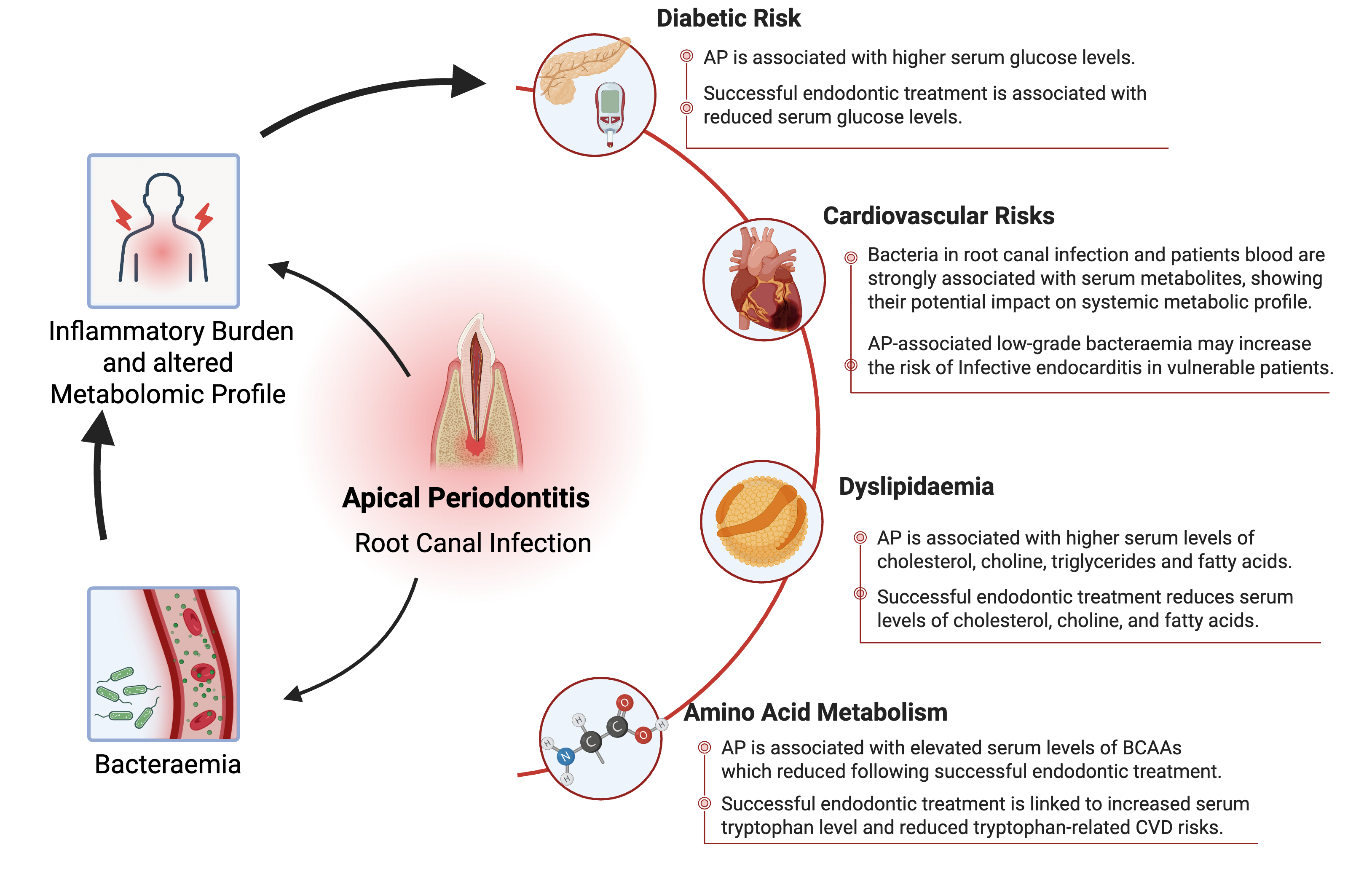
Published in the Journal of Translational Medicine, this integrated, multilayered research represents one of the most comprehensive study that tracked 45 blood markers in patients before and after endodontic treatment over two years. The findings showed:
- Blood sugar levels dropped significantly and stayed lower for two years, reducing diabetes risk.
- Cholesterol and fatty acids improved within months, supporting heart health.
- Inflammatory markers declined progressively, lowering cardiovascular risk.
This is a true paradigm shift, supported by robust evidence, and is crucial for educating both the public and healthcare professionals.
Why It Matters
Long-standing tooth infections allow bacteria to enter the bloodstream, triggering inflammation and disrupting metabolism. Treating these infections restores balance - impacting blood sugar, cholesterol, and systemic inflammation.
According to the WHO, 3.7 billion people globally live with untreated oral disease. Apical Periodontitis is the third most prevalence oral disease. “Given the broader health impact of Apical Periodontitis, it's treatment should be integrated into a patient’s general healthcare” - Dr Sadia Niazi.
A 2021 public health survey public health survey revealed that over one-third of adults in England have undergone root canal treatment, rising to nearly 50% among those aged 55 to 74, placing root canal treatment as one of the most common dental procedures- yet myths and misinformation, often fueled by outdated anecdotes from a century ago and amplified on social media, have created unnecessary fear and confusion. This landmark study delivers robust scientific evidence to debunk these myths, proving that endodontic therapy is not only safe and effective but also offers systemic health benefits.
Dr Sadia Niazi’s message for Healthcare providers and Policy makers
Read the full study: Journal of Translational Medicine
Read Dr Sadia Niazi’s Interview by The American Association of Endodontists: Beyond the Tooth: How Endodontic Treatment May Improve Systemic Metabolic Health
Related Scientific Publications funded by the BES:
- Bakhsh, A., Joseph, S., Mannocci, F., Proctor, G., Moyes, D., & Niazi, S.A. (2025) Apical Periodontitis microbiome association with salivary and serum inflammatory burden. International Endodontic Journal. 58(3):504-515
- Bakhsh, A., Moyes, D., Mannocci, F., Proctor, G., & Niazi, S.A. (2025) Links between Nosocomial Endodontic Infections and Bacteremia Associated with Apical Periodontitis and Endodontic Treatment. Journal of Endodontics 51(2):140-149
- Bakhsh, A., Moyes, D., Proctor, G., Mannocci, F., & Niazi, S.A. (2022). The impact of apical periodontitis, non-surgical root canal retreatment and periapical surgery on serum inflammatory biomarkers. International Endodontic Journal, 55(9), 923-937
- Al-Abdulla, N., Bakhsh, A., Mannocci, F., Proctor, G., Moyes, D., Niazi, S.A. (2023) Successful endodontic treatment reduces serum levels of cardiovascular disease risk biomarkers-high-sensitivity C-reactive protein, asymmetric dimethylarginine, and matrix metalloprotease-2. International Endodontic Journal 56(12):1499-1516